
RYA Day Skipper Theory
Foundational chartwork, tides, pilotage, weather, COLREGs, safety and passage-planning revision.
€5.9917 modules
View course Compass Ireland is independent and is not affiliated with or endorsed by Irish Sailing, the RYA, the Department of Transport, ComReg, or Met Éireann. It does not award qualifications or radio certificates.
Compass Ireland
Irish sailing pathways and independent revision, connecting local guidance with the right RYA-aligned study route.
Independent preparation. No qualification or certificate awarded.
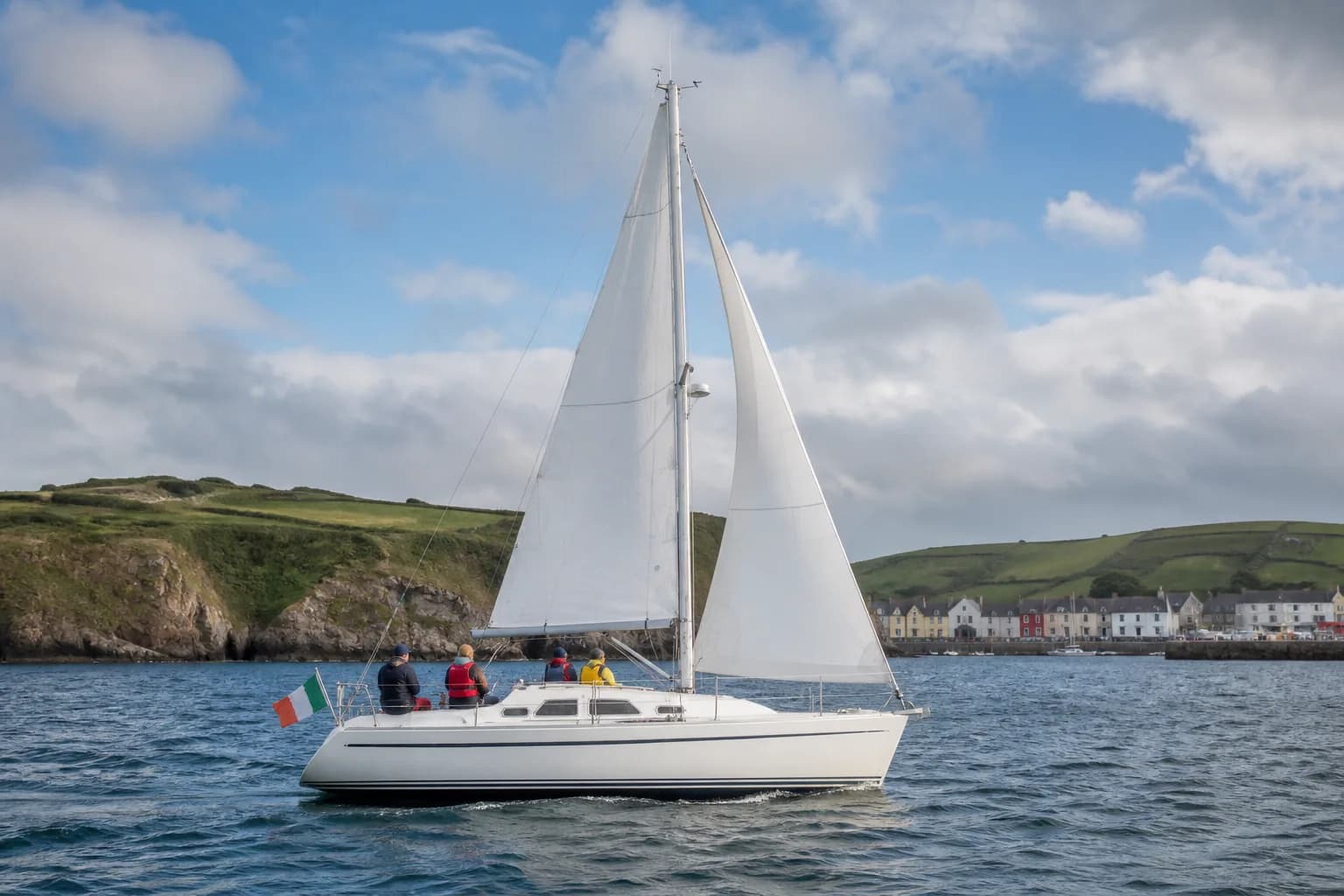
Use Irish pathway, radio, and ICC context around the existing Compass RYA-aligned courses. EUR offers grant the same underlying entitlements rather than creating duplicate Irish courses. Irish English. Nautical and metric units. Sources include Irish Sailing, Department of Transport, ComReg.
Irish pathway guidance is reviewed against current official Irish sources. Existing RYA-aligned course content retains its stated syllabus and jurisdictional boundaries.
Try the learning experience
Explore a real sample from RYA Day Skipper Theory. Learn the idea, practice a decision, then check your understanding. No account needed for this sample.
Ireland guides you into our existing independent RYA-syllabus revision products; this is not a separate Irish qualification.
Explore this companionLearn · teaching first
From Nautical Terms
What you will learn
Identify the vessel's port and starboard sides from any position aboard and relate them to navigation sidelights without confusing buoyage regions.
Port and starboard are fixed sides of the vessel: port is left and starboard is right when you face the bow.
When facing forward, the left side of the boat is port and the right side is starboard. Navigation sidelights are red to port and green to starboard. Lateral buoy colours are jurisdiction-specific: the UK uses IALA Region A, where port-hand marks are red and starboard-hand marks are green in the direction of buoyage; Region B reverses those lateral colours.
A useful mnemonic: 'port' and 'left' both have four letters. Another: 'Is there any RED PORT LEFT in the bottle?'
Interpret an instruction from anywhere aboard
You are standing in the cockpit facing the stern when someone reports a fender dragging on the starboard side. The vessel's starboard side has not changed just because you turned around.
Sense check: A vessel's port sidelight remains red worldwide; IALA Region A or B changes lateral-mark colours, not the vessel's sidelights.
Common mistake
Port and starboard belong to the vessel and do not swap when a crew member faces aft.
Recap
Flashcards, audio and interactive tools remain optional support inside the module; they do not replace the Learn → Practise → Test route.
Study collection
Foundational chartwork, tides, pilotage, weather, COLREGs, safety and passage-planning revision.
Advanced coastal passage-making, night navigation, tidal strategy, meteorology and pilotage revision.
The Coastal Skipper foundation plus distinct Yachtmaster assessment and command-decision practice.
VHF, DSC, licensing, channel choice, distress procedure, spoken-call and mock-assessment revision.
Exam-style revision for European inland waterway signs, rules, lights, sound signals, and ICC inland validation context.
Powerboat and ICC preparation for Level 2 background knowledge, safety checks, close-quarters handling concepts, man overboard, anchoring, COLREGs, buoyage, and short passages.
Sea survival revision for lifejackets, liferafts, abandoning ship, cold water, emergency signalling, search and rescue, and survival priorities.
Revision for boating first-aid topics: emergency response, CPR and drowning, cold shock, hypothermia, bleeding, seasickness, VHF medical advice, and helicopter rescue.
Radar revision for small craft navigation, collision avoidance, restricted visibility, plotting, controls, and radar-pilotage decisions.
Separate course choice, practical training, certification, and assessment.
Understand distinct radio, competency, and operator-acceptance boundaries.
Join the Irish pre-course resource pilot.
Independent and source-reviewed
Irish pathway guidance is reviewed against current official Irish sources. Existing RYA-aligned course content retains its stated syllabus and jurisdictional boundaries. Compass Ireland is independent and is not affiliated with or endorsed by Irish Sailing, the RYA, the Department of Transport, ComReg, or Met Éireann. It does not award qualifications or radio certificates.