New Zealand Day Skipper Study Companion
Independent New Zealand Day Skipper knowledge preparation with Part 91 and local-rule boundaries.
$39.998 modules
View course Compass New Zealand is independent and is not affiliated with, approved by, or endorsed by Coastguard Boating Education, Maritime New Zealand, Radio Spectrum Management, or MetService. It does not award Day Skipper, Boatmaster, MVOC, or NZQA certification.
Compass New Zealand
Independent New Zealand Day Skipper, Maritime VHF and Boatmaster preparation, with local knowledge at its heart.
Independent preparation. No qualification or certificate awarded.
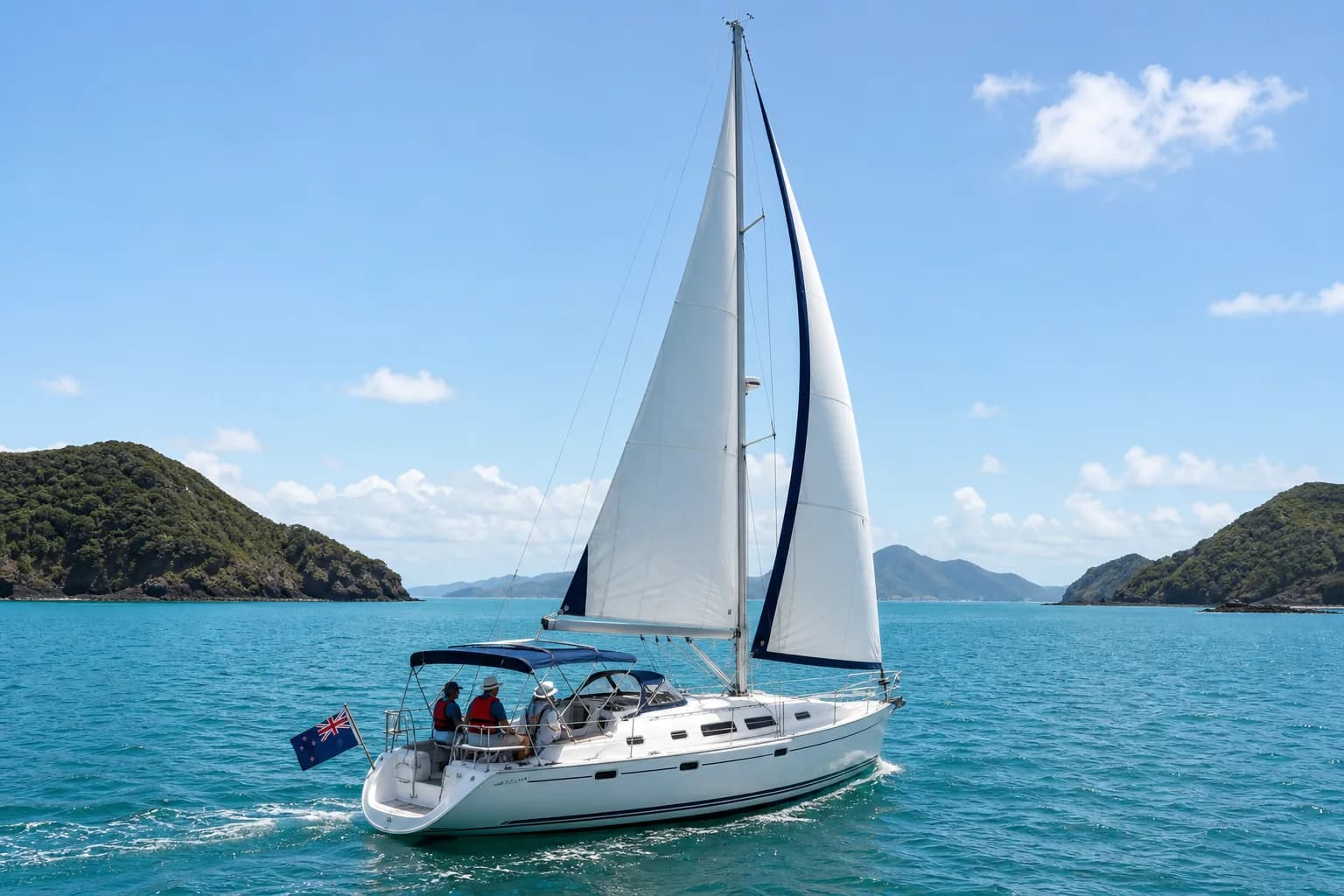
Prepare with New Zealand English, IALA Region A, Maritime Rules and bylaws, local weather sources, and clear certification and practical-training boundaries. New Zealand English. Nautical miles and knots; metres, litres, Celsius, and hPa. Sources include Maritime NZ, Radio Spectrum Management, MetService.
Original content is reviewed against current New Zealand course outcomes, maritime rules, radio guidance, and weather sources. Regional bylaws and current notices must be checked separately.
Try the learning experience
Explore a real sample from New Zealand Day Skipper Study Companion. Learn the idea, practice a decision, then check your understanding. No account needed for this sample.
Progress in this sample stays in the sample. It does not change your course record or award a qualification.
Explore this companionLearn · teaching first
From Boat Components and Equipment
What you will learn
Use a repeatable walk-round to identify what each essential component does, where it is, what normal looks like and what evidence would stop departure.
A list of nouns is not boat knowledge. The useful question is whether the learner can trace a system from its function to a real control, recognise an abnormal state and explain what will happen next.
Know the function and location of essential equipment. Treat boat parts as connected safety functions, not an isolated vocabulary list. Begin in one place and move systematically around the actual boat, outside and inside. Group what you see by function: keep water out, remove unwanted water, control direction, create propulsion, store and distribute energy, contain fire and fuel risk, communicate and recover people. The same part can support several functions, so record both its name and its job.
For each essential item use FUNCTION — LOCATION — NORMAL STATE — FAILURE CLUE — CONTROL — NO-GO TRIGGER. Point to the item or control; describe its expected condition or indication; identify one observable sign that it is damaged, unavailable or doubtful; and state the boat-specific isolation, fallback or no-go route. Do not invent a valve, switch, bung or procedure merely because another boat had one.
Give a function-first handover
A second person may need to stop the engine, call for help or begin dewatering if the skipper is incapacitated.
Sense check: A briefing is incomplete if the listener can repeat the name but cannot locate the item.
Common mistake
Memorising component names without tracing their safety function
Recap
Flashcards, audio and interactive tools remain optional support inside the module; they do not replace the Learn → Practise → Test route.
Study collection
Independent New Zealand Day Skipper knowledge preparation with Part 91 and local-rule boundaries.
New Zealand Maritime VHF preparation that explicitly excludes DSC and SSB from the MVOC route.
Independent New Zealand Boatmaster preparation with original no-recording oral scenarios.
New Zealand Boating Pathway Bundle
Day Skipper, Maritime VHF, and Boatmaster study companions.
Understand progression without claiming certification equivalence.
Rehearse fictional calls without recording or transmitting audio.
Register interest in the narrow pre-course preparation pilot.
Independent and source-reviewed
Original content is reviewed against current New Zealand course outcomes, maritime rules, radio guidance, and weather sources. Regional bylaws and current notices must be checked separately. Compass New Zealand is independent and is not affiliated with, approved by, or endorsed by Coastguard Boating Education, Maritime New Zealand, Radio Spectrum Management, or MetService. It does not award Day Skipper, Boatmaster, MVOC, or NZQA certification.